Building an appetite for DEIB,
one breath at a time

Blog

Your blog category

Pride in Corporate India: How Far Have We Come, and How Far Do We Still Need to Go?

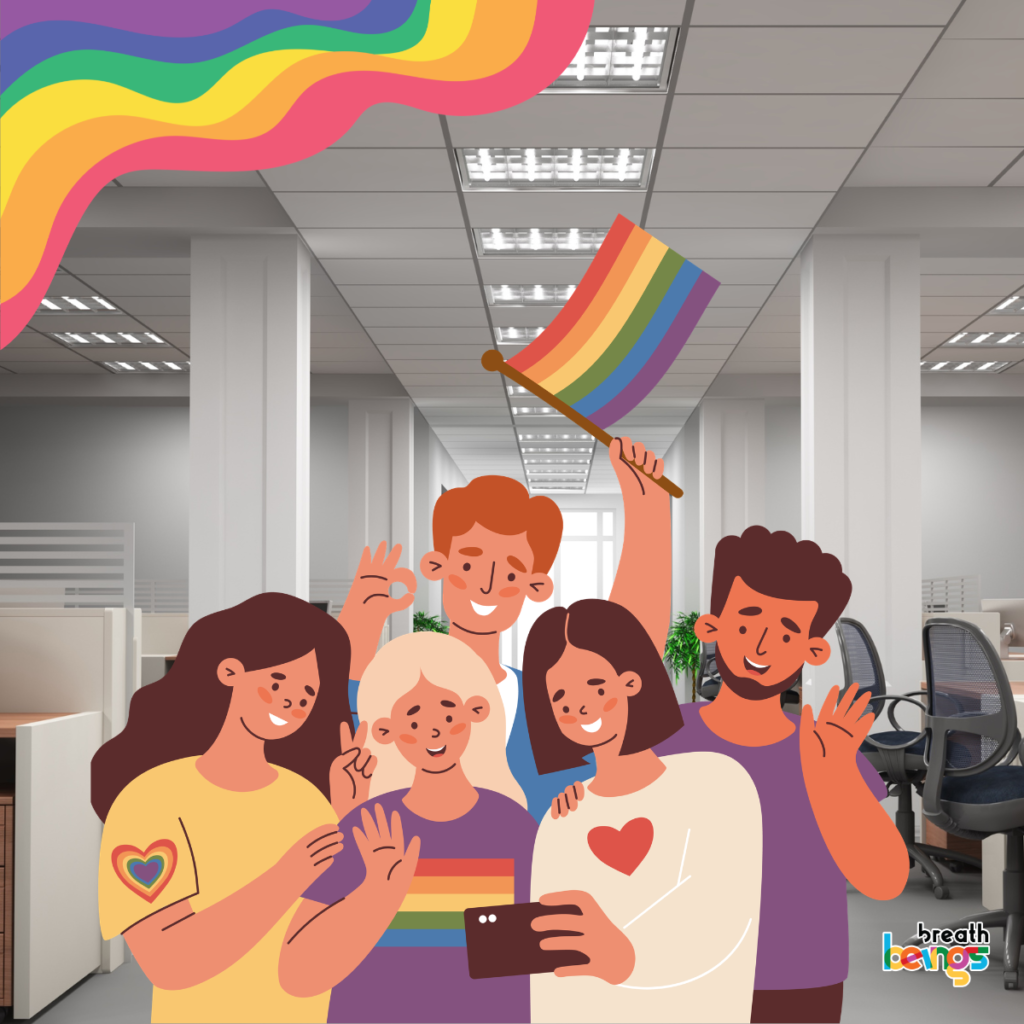
The characters are diverse in appearance and are rendered in a flat, illustrative style with warm, earthy tones for skin and hair. From left to right, the first character is a woman with long, dark wavy hair, wearing a yellow t-shirt adorned with a rainbow heart on the sleeve. She is smiling and holding a phone as if taking a selfie. Next to her is a woman with short blonde hair, wearing a purple t-shirt with rainbow stripes. She is also smiling and making a peace sign with her fingers. Behind them, a man with short red hair and a blue shirt is smiling and holding up one hand in a wave or gesture of acknowledgement. To the right of the blonde woman is another woman with short brown hair, wearing a cream-colored shirt with a red heart graphic. She is also smiling and holding the phone for the selfie. Completing the group on the far right is a man with short curly brown hair and a purple t-shirt, smiling and waving. A rainbow flag on a wooden pole is held high by one of the individuals, its colors vibrant against the neutral office background. Above the characters, a stylized rainbow wave flows across the top of the image, further emphasizing the LGBTQ+ theme

In 2018, when India decriminalized same-sex relationships, it marked a historic legal victory. For many organizations, it also became the moment to start conversations about LGBTQIA+ inclusion.
Fast forward to today, and the landscape looks remarkably different.
Rainbow logos appear every June. Companies host Pride panels, allyship workshops, and awareness campaigns. Employee Resource Groups (ERGs) are thriving. Inclusive policies are finding their way into employee handbooks. More leaders are speaking publicly about allyship than ever before.
These are meaningful shifts.
But an important question remains:
Has inclusion become part of how organizations function, or is it still something they celebrate once a year?
The answer, for many workplaces, is somewhere in between.

Pronouns, Policies and People: What Every Manager Should Know This Pride Month

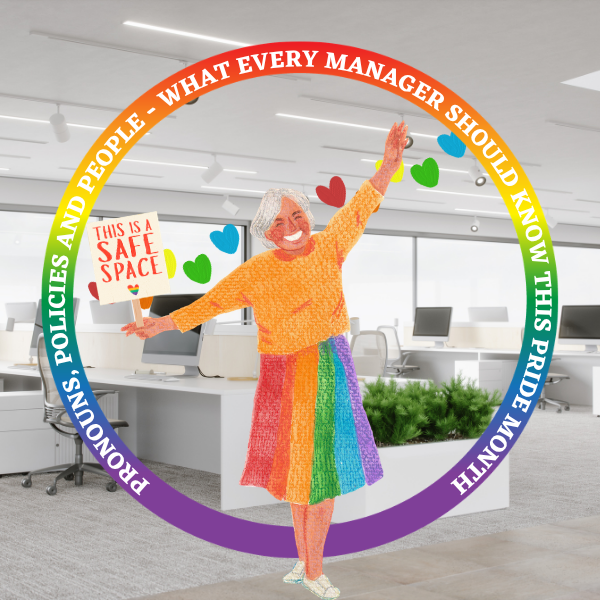
The image depicts a vibrant and inclusive scene set within a modern office environment. The central focus is a smiling person, rendered in a colorful, illustrative style, who stands with arms outstretched in a celebratory pose. This individual wears a bright orange sweater and a skirt adorned with the colors of the rainbow flag, symbolizing LGBTQ+ pride. Surrounding the central figure is a large, curved text banner, also designed with the rainbow color spectrum, starting with purple at the bottom and transitioning through blue, green, yellow, orange, and red at the top. The text inscribed on this banner reads: "PRONOUNS, POLICIES AND PEOPLE - WHAT EVERY MANAGER SHOULD KNOW THIS PRIDE MONTH".

Most organisations today have something written down: an anti-discrimination clause, a commitment to LGBTQIA+ workplace inclusion, sometimes even further, gender-neutral restrooms, transition support guidelines, pronoun fields in HR systems. All of that matters. And yet, the gap between what’s in a policy document and what someone actually experiences at work is almost always a human gap. A manager gap.
Most organisations today have something written down: an anti-discrimination clause, a commitment to LGBTQIA+ workplace inclusion, sometimes even further — gender-neutral restrooms, transition support guidelines, pronoun fields in HR systems. All of that matters. And yet, the gap between what’s in a policy document and what someone actually experiences at work is almost always a human gap. A manager gap.
Your team members don’t experience your organisation’s inclusion stance as a PDF. They experience it in how you respond when someone shares something personal. In whether you address the joke that shouldn’t have landed, or let it pass. In whether they feel they can bring their full selves to work without bracing for a reaction.

3 Quick POSH Readiness Checks Organisations Can Do This Week

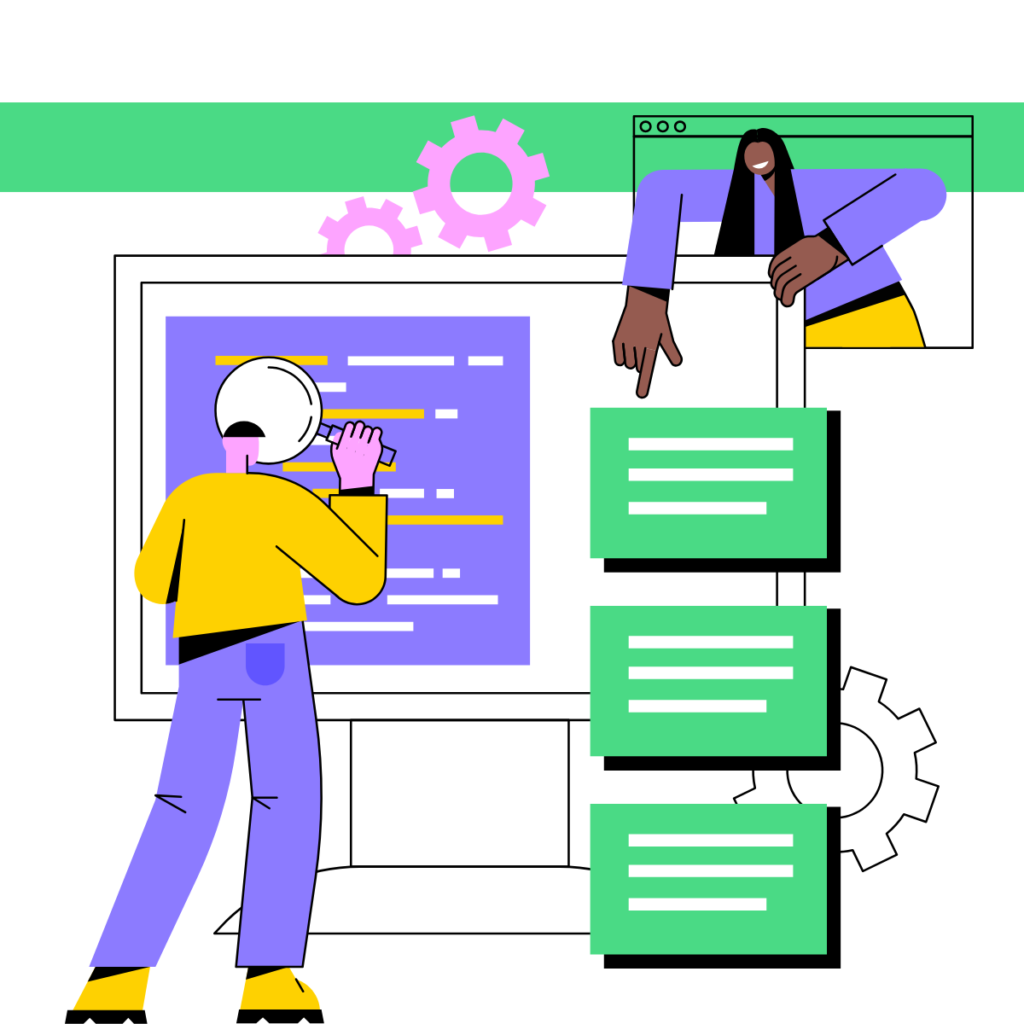
Two people are looking at a computer screen with lines of code. One person is using a magnifying glass to examine the code, while the other person is pointing at a series of green boxes with lines on them. Gears are in the background.

Most organisations today have a POSH policy in place, but policies alone do not always ensure that systems are ready to respond when concerns arise. This article explores three quick readiness checks organisations can conduct internally, from reviewing Internal Committee composition to assessing employee awareness and documentation practices.That’s not just a statistical concern, it’s a trust issue.
Deloitte’s Women @ Work 2024 report highlights that 43% of women in India have experienced harassment or non-inclusive behavior at work. And nearly half worry about their safety, not only at work, but on their way to it.
But here’s the other side of the story, rising reports reflect rising courage. More people are choosing to speak up. More people believe that being heard is possible.

International Women’s Day 2026: Give to Gain: What Are We Willing to Let Go Of?

The image depicts two women in an office environment; one is seated at a desk, working on a laptop, while the other stands behind her, seemingly engaged in the work process. The seated woman has fair skin, long brown hair, and is wearing a tan blazer over a dark top, accessorized with hoop earrings. She is smiling slightly, conveying a pleasant and approachable demeanor. In front of her is a laptop, a notebook, and a mouse on a light brown desk. The standing woman has dark skin, curly dark hair, and is wearing a teal blazer over a white collared shirt. She also has hoop earrings and is smiling warmly, creating a welcoming and collaborative atmosphere. Behind her is a large window with a view of buildings, suggesting a city office. The office setting includes a shelf with plants and books, adding a touch of nature and organization to the space. There is also a black computer monitor next to the desk and a pencil on the desk

Yes, organisations must give:
Give sponsorship.
Give opportunities.
Give pay equity.
Give visibility.
Give leadership development.
But we must also give up:
Bias.
Microaggressions.
Stereotypes.
Outdated norms.
Because progress is not only about adding more support. It’s about removing the invisible friction that slows equity down.
This International Women’s Day 2026, under the theme Give to Gain, the real question isn’t only:
“What are we giving?”
It’s also:
“What are we finally ready to let go of?”

When Inclusion Becomes Culture: The Shift from Counting Diversity to Living It

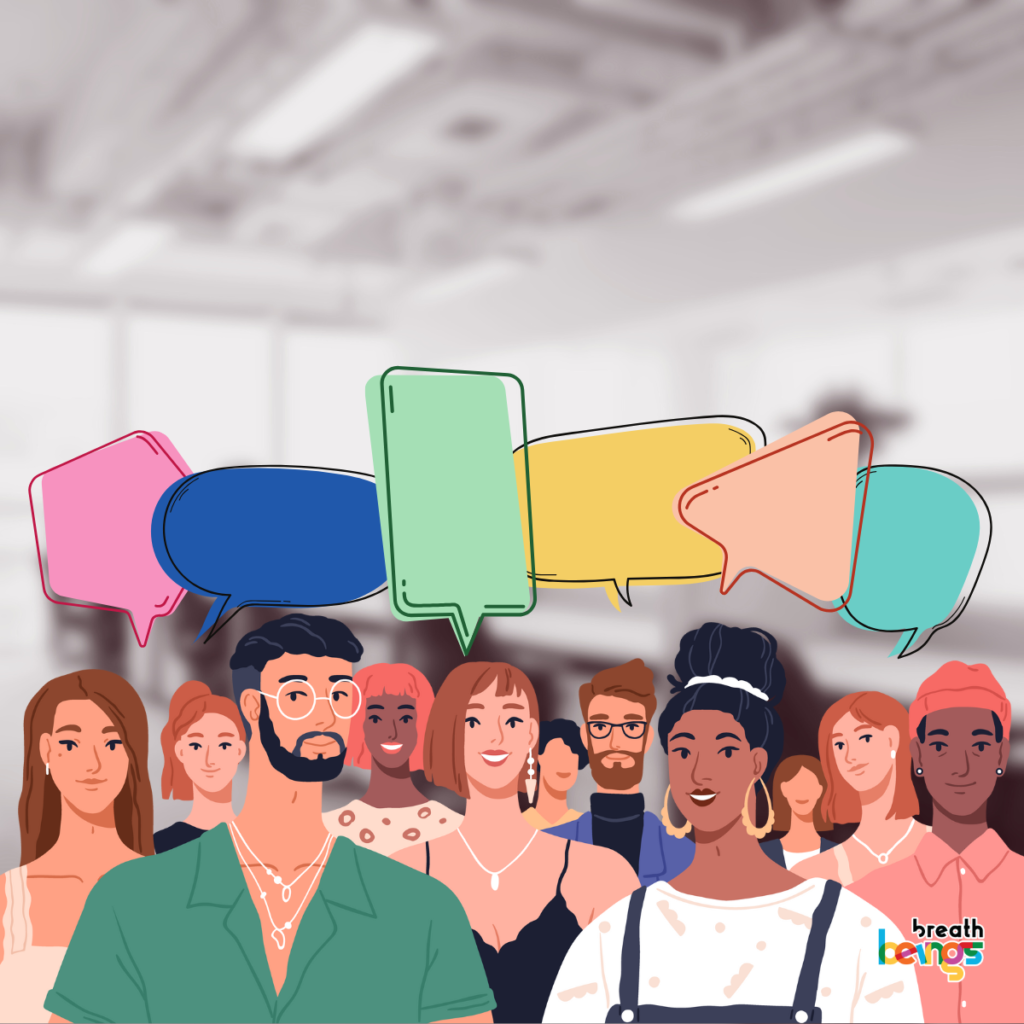
The image illustrates a diverse group of people standing together with colorful speech bubbles floating above them, suggesting a discussion or exchange of ideas. In the foreground, a collection of diverse individuals are depicted with varying skin tones, hairstyles, and clothing styles. A man with a beard and glasses wears a green shirt and a necklace with multiple strands, standing slightly to the left of the center. To his right, a woman in a black top and a delicate necklace smiles forward. A woman with her hair styled in an updo and large hoop earrings stands prominently in the front row. The group as a whole appears friendly and approachable. Above the group of people, there are speech bubbles in vibrant colors such as pink, blue, green, yellow, and orange, adding a playful and dynamic element to the composition.

Workplace inclusion has come a long way from posters and promises. For years, metrics around diversity, equity, inclusion, and belonging (DEIB) focused on representation, tracking gender ratios, diverse hiring numbers, or promotion rates. Those numbers are important, yet they only scratch the surface.
In 2025, organizations across industries are beginning to ask a deeper question:
“How do we measure the quality of our culture, not just the quantity of our diversity?”
Because true inclusion isn’t about simply having diverse talent on board; it’s about ensuring that people, of every background, identity, and ability, feel welcome, respected, and empowered to thrive.

How Organizations Can Build Respectful, Safer Workplaces: Best Practices and Strategies

A large hand holds three stylized figures, representing people working collaboratively, illustrating the concept of building respectful workplaces. The figures are positioned centrally within the hand, creating a sense of protection and support. The three figures are stylized cartoon representations of people working. The woman on the left is engaged in a relaxed and friendly-looking pose, holding a cup. The woman in the middle is looking upwards, and the man on the right is seated and working on a laptop. The setting is abstract, suggesting a general workplace environment with the figures presented as if they were part of a supportive environment.

In recent years, a growing body of data has brought clarity to what many employees already know from lived experience. According to The Udaiti Foundation’s 2023–24 report, NSE-listed companies in India reported 2,325 cases of workplace sexual harassment, a 29% increase from the previous year. Perhaps more tellingly, pending complaints rose by 67%, with 435 cases left unresolved by year-end.
That’s not just a statistical concern, it’s a trust issue.
Deloitte’s Women @ Work 2024 report highlights that 43% of women in India have experienced harassment or non-inclusive behavior at work. And nearly half worry about their safety, not only at work, but on their way to it.
But here’s the other side of the story, rising reports reflect rising courage. More people are choosing to speak up. More people believe that being heard is possible.

How Women Are Quietly Redefining Leadership

The image features five stylized illustrations of women, each depicted in a different colored circle connected to form a continuous cycle. They are positioned against a blurred backdrop of a contemporary office space with large windows offering a city view and modern office furniture, including desks and chairs. The women are depicted in various professional poses and activities.One woman, in a rust-colored blazer and dark pants, stands with her arms crossed, a confident posture with an upward-trending arrow emerging from behind her, symbolizing growth or success. Another is holding sticky notes, suggesting brainstorming or planning. Another is shown on a phone, holding a tablet, indicating communication and coordination. A fourth woman appears to give a presentation or explanation, gesturing with one hand and holding a document in the other. Lastly, the fifth woman has a relaxed posture with her arms crossed, suggesting the contemplation or assessment phase. Each woman is dressed in smart casual business attire. The color palette is soft and pastel, with each woman’s circle a different bright color.

Leadership doesn’t look like it used to.
It’s no longer about standing at the top of the pyramid, giving orders from a distance. Today, more than ever, leadership is about connection, care, and collaboration. And women are at the heart of this shift.
Across industries and geographies, women are rewriting what it means to lead, with empathy, adaptability, and a sense of shared purpose. This isn’t about fitting into outdated molds. It’s about reshaping leadership into something more human, more inclusive, and ultimately, more effective.

Intellectual property rights

You are not permitted to use this Website for any purpose other than knowledge and understanding of Breath Beings products and services.

All content in all forms on this Website, including (but not limited to) blogs, data, photographs,illustrations, logos and information belong exclusively to Breath Beings, unless explicitly stated. You shall not modify, distribute, perform, link, display, edit, or in any way exploit any of the content in part or in whole. Any modification or use shall be made only with the express written consent of the Creative Director at Breath Beings Pvt Ltd (write to aruna@breathbeings.in). Any extraction of the intellectual property of Breath Beings Pvt Ltd from this Website is prohibited.

By using this Website, you agree that all of Breath Being’s trademarks,signature programmes, copyrights, logos, product and brand features, service names are trademarks and property of Breath Beings Pvt Ltd.

All content, including but not limited to the format, script, dialogues, titles, and presentation of games, acts, and theatre plays created by Breath Beings Pvt Ltd are protected by the copyright laws of India. These intellectual property rights are owned by Breath Beings Pvt Ltd and are an integral part of our product offerings.

No part of our games, acts, and plays, including the format, script, dialogues, titles, and presentation, may be reproduced, distributed, or transmitted in any form or by any means, including photocopying, recording, or other electronic or mechanical methods, without the prior written permission of Breath Beings Pvt Ltd.

Breath Beings Pvt Ltd reserves the right to enforce its intellectual property rights to the fullest extent of the law. All rights not expressly granted in this disclaimer are reserved.

For inquiries regarding the use or licensing of our copyrighted materials, please contact us at begin@breathbeings.in

Thank you for respecting our intellectual property rights.

Breath Beings – REGD. OFFICE:
No. 198, CMH Road, 2nd Floor, Indiranagar, Bangalore North,
Bangalore – 560038, Karnataka (IN)