Building an appetite for DEIB,
one breath at a time

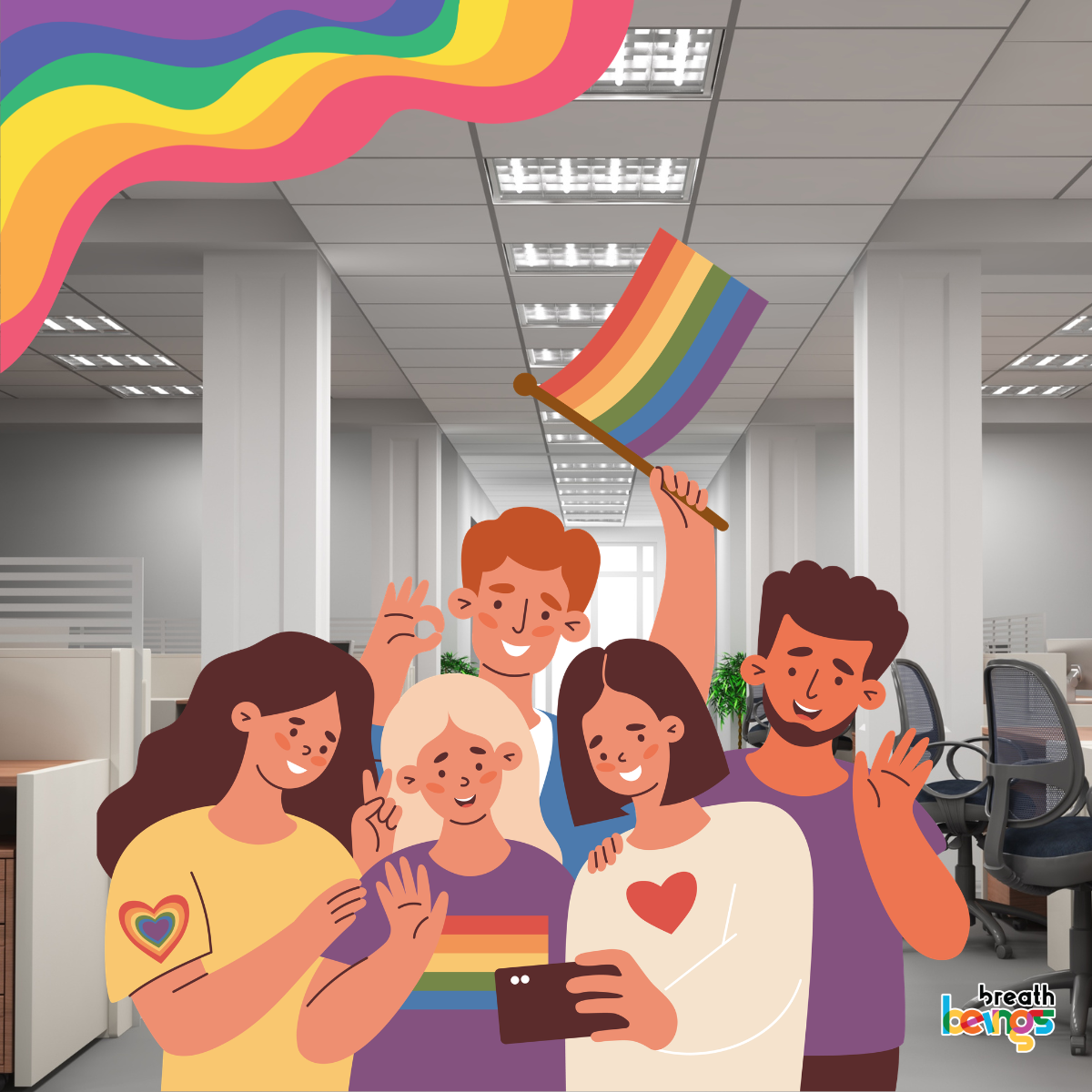
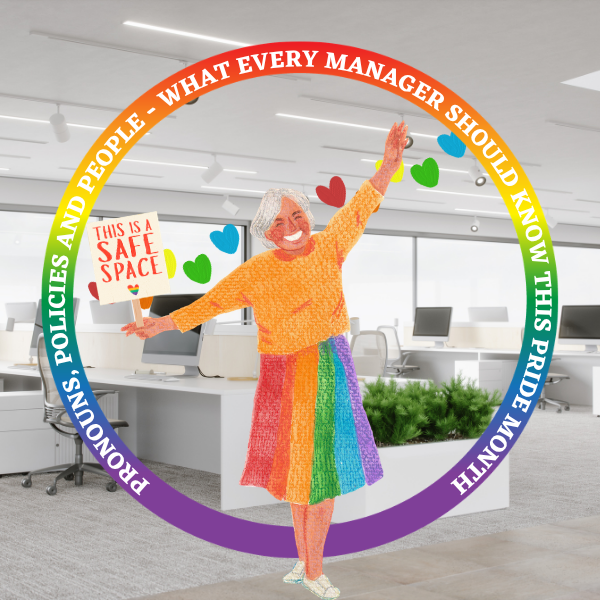
The image depicts a vibrant and inclusive scene set within a modern office environment. The central focus is a smiling person, rendered in a colorful, illustrative style, who stands with arms outstretched in a celebratory pose. This individual wears a bright orange sweater and a skirt adorned with the colors of the rainbow flag, symbolizing LGBTQ+ pride. Surrounding the central figure is a large, curved text banner, also designed with the rainbow color spectrum, starting with purple at the bottom and transitioning through blue, green, yellow, orange, and red at the top. The text inscribed on this banner reads: "PRONOUNS, POLICIES AND PEOPLE - WHAT EVERY MANAGER SHOULD KNOW THIS PRIDE MONTH".

Pronouns, Policies and People: What Every Manager Should Know This Pride Month

, 3 mins read

Pride Month has a way of bringing certain conversations to the surface, conversations about identity, belonging, and what it actually means to build an LGBTQ+ inclusive workplace. And while these conversations matter beyond June, this is as good a time as any to sit with them honestly.

This isn’t about getting everything right. It’s about being willing to learn, stumble a little, and keep going anyway, especially if you’re a manager, because your team feels your example more than they read any policy.

Why workplace policy alone doesn't create inclusion

Most organisations today have something written down: an anti-discrimination clause, a commitment to LGBTQIA+ workplace inclusion, sometimes even further, gender-neutral restrooms, transition support guidelines, pronoun fields in HR systems. All of that matters. And yet, the gap between what’s in a policy document and what someone actually experiences at work is almost always a human gap. A manager gap.

Your team members don’t experience your organisation’s inclusion stance as a PDF. They experience it in how you respond when someone shares something personal. In whether you address the joke that shouldn’t have landed, or let it pass. In whether they feel they can bring their full selves to work without bracing for a reaction.

Inclusion isn’t written. It’s enacted, every day, in ordinary moments.

Using correct pronouns at work: why it matters more than you think

There’s often more anxiety around pronouns in the workplace than there needs to be. And underneath that anxiety is usually a worry about getting it wrong.

Here’s the thing: getting it wrong and correcting yourself is far less harmful than not trying at all, or treating the conversation as too uncomfortable to have.

When someone shares their pronouns, they’re extending trust. They’re telling you something about how they move through the world and asking you to meet them there. That’s not a political act. It’s a human one.

The most useful thing a manager can do isn’t to make a big moment of it, it’s to make it unremarkable.

  • Introduce yourself with your own pronouns, so it becomes a team norm rather than an individual burden
  • If you make a mistake, correct it briefly and move on, apologies tend to centre the wrong person
  • When unsure, ask quietly and respectfully, rather than guessing or avoiding the person altogether

Confidentiality: the non-negotiable part of LGBTQ+ allyship
The image depicts a vibrant and inclusive scene set within a modern office environment. The central focus is a smiling person, rendered in a colorful, illustrative style, who stands with arms outstretched in a celebratory pose. This individual wears a bright orange sweater and a skirt adorned with the colors of the rainbow flag, symbolizing LGBTQ+ pride. Surrounding the central figure is a large, curved text banner, also designed with the rainbow color spectrum, starting with purple at the bottom and transitioning through blue, green, yellow, orange, and red at the top. The text inscribed on this banner reads: "PRONOUNS, POLICIES AND PEOPLE - WHAT EVERY MANAGER SHOULD KNOW THIS PRIDE MONTH".

If someone comes out to you, that story is theirs to tell. Not yours to share with HR “just so they know,” not yours to mention to their colleagues with good intentions, not yours to bring up because you thought it would help.

Outing someone, even accidentally, even kindly, can cause harm that’s difficult to undo. The trust it breaks is hard to rebuild.

The rule is simple: if they told you, they decide what happens next.

Building a workplace culture of belonging beyond Pride Month

The organisations that genuinely get LGBTQ+ inclusion right aren’t always the loudest in June. They’re the ones where queer employees don’t spend the rest of the year wondering whether they’re actually welcome, or just tolerated during awareness months.

This Pride Month, the most meaningful question a manager can sit with isn’t “what should we do for Pride?” 

 It’s: do the people on my team feel as safe, as seen, and as included in November as they do right now? And if not, what am I actually willing to do about it?

You don’t need all the answers. But you do need to create space for the questions to be asked.

At Breath Beings, we work with organisations and their managers to build inclusion that outlasts any awareness month. If you’d like to explore what that looks like for your team, we’d love to hear from you.
Table of Content

Subscribe to our monthly DEIB newsletter

Explore Resources

Share this post

Other Posts

Refers to the often undervalued and gender-biased tasks, such as event planning and administrative duties, disproportionately assigned to certain individuals
, 3 mins read
Storytelling is as old as humanity itself. It has been one of the oldest forms of communication and building mutual
, 5 mins read
To create a truly inclusive space, organizations have implemented many changes, making their policies and mindsets more welcoming towards LGBTQIA+
, 5 mins read

Intellectual property rights

You are not permitted to use this Website for any purpose other than knowledge and understanding of Breath Beings products and services.

All content in all forms on this Website, including (but not limited to) blogs, data, photographs,illustrations, logos and information belong exclusively to Breath Beings, unless explicitly stated. You shall not modify, distribute, perform, link, display, edit, or in any way exploit any of the content in part or in whole. Any modification or use shall be made only with the express written consent of the Creative Director at Breath Beings Pvt Ltd (write to aruna@breathbeings.in). Any extraction of the intellectual property of Breath Beings Pvt Ltd from this Website is prohibited.

By using this Website, you agree that all of Breath Being’s trademarks,signature programmes, copyrights, logos, product and brand features, service names are trademarks and property of Breath Beings Pvt Ltd.

All content, including but not limited to the format, script, dialogues, titles, and presentation of games, acts, and theatre plays created by Breath Beings Pvt Ltd are protected by the copyright laws of India. These intellectual property rights are owned by Breath Beings Pvt Ltd and are an integral part of our product offerings.

No part of our games, acts, and plays, including the format, script, dialogues, titles, and presentation, may be reproduced, distributed, or transmitted in any form or by any means, including photocopying, recording, or other electronic or mechanical methods, without the prior written permission of Breath Beings Pvt Ltd.

Breath Beings Pvt Ltd reserves the right to enforce its intellectual property rights to the fullest extent of the law. All rights not expressly granted in this disclaimer are reserved.

For inquiries regarding the use or licensing of our copyrighted materials, please contact us at begin@breathbeings.in

Thank you for respecting our intellectual property rights.

Breath Beings – REGD. OFFICE:
No. 198, CMH Road, 2nd Floor, Indiranagar, Bangalore North,
Bangalore – 560038, Karnataka (IN)