
Becoming a manager is often seen as a promotion. In reality, it is a shift in how you work, how you measure success and, most importantly, how you lead.
One day, your success is largely defined by your own output. The next, it depends on how well you help other people perform, grow, collaborate and navigate challenges.
That is why the first 90 days can feel unfamiliar, even for high-performing professionals.
The challenge isn’t necessarily that new managers lack expertise. It is that many of the habits that made them successful as individual contributors don’t automatically make them effective managers.
The first 90 days are therefore less about proving yourself and more about making a fundamental shift: from doing the work yourself to creating the conditions for others to do their best work.
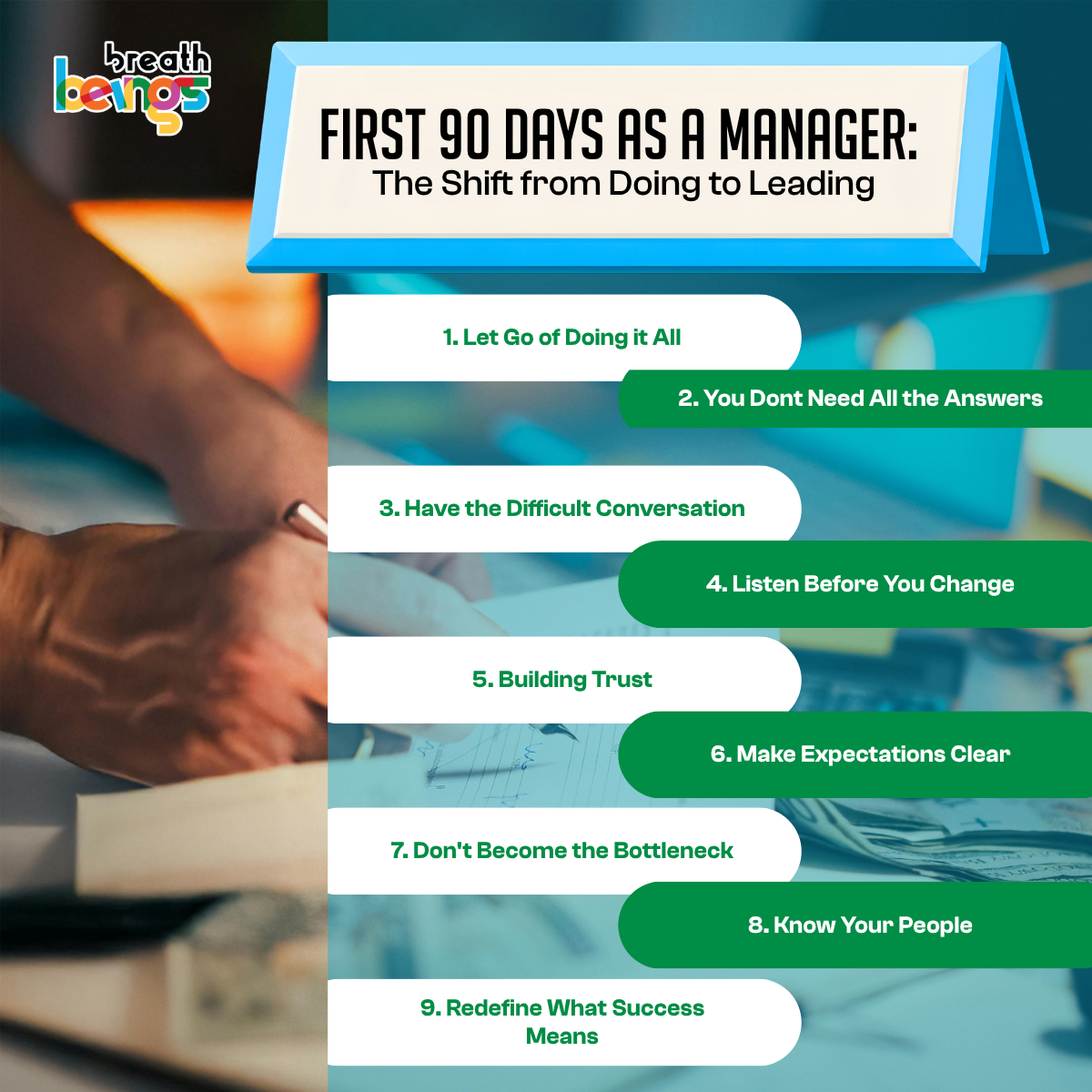
Here are nine shifts that can help first-time managers navigate that transition.
1. Let Go of Doing It All
One of the hardest parts of becoming a manager is letting go of work you previously owned.
New managers often step in to fix problems, take over difficult tasks or redo work when it doesn’t meet their standards. While the intention may be to protect quality, it can leave the manager overwhelmed and the team with fewer opportunities to build ownership.
What to do instead: Delegate with purpose. Give people responsibility, decision-making space and the support they need to succeed.
2. You Don’t Need All the Answers
New managers can feel pressure to have an answer for every question and a solution for every problem.
But effective management isn’t about being the smartest person in the room. Sometimes, it is about asking better questions:
- What do you think we should do?
- What options have you considered?
- What information are we missing?
- What support do you need from me?
A manager’s value isn’t always in providing the answer. It can be in helping the team find one.
3. Have the Difficult Conversation
Giving feedback to a peer is difficult. Giving feedback after becoming their manager can feel even more uncomfortable.
Avoiding these conversations, however, rarely makes things better. Missed expectations continue, small frustrations grow and feedback arrives too late to be useful.
What to do instead: Address concerns early. Focus on observable behaviour and its impact rather than labels or assumptions.
Difficult conversations don’t become easier by avoiding them.
4. Listen Before You Change
A new manager often arrives with ideas: new processes, new ways of working and new expectations.
The desire to make an immediate impact is understandable. But changing everything too quickly can mean missing the context behind how the team currently works.
Before making changes, ask:
- What is working well?
- Where are the biggest frustrations?
- What should we not change?
- What does the team need more of?
Listen first. Then act.
5. Build Trust
The transition from peer to manager can make relationships complicated. Some new managers may avoid setting boundaries or holding people accountable because they don’t want to be seen as difficult.
But being liked and being trusted are not the same thing.
Trust grows through consistency, fairness and clarity.
You don’t need to make everyone happy. You need to be someone your team can rely on.
6. Make Expectations Clear
New managers sometimes assume their team knows what good performance looks like.
But what feels obvious to one person may be unclear to another.
Make the basics visible:
- Priorities
- Roles and responsibilities
- Decision-making authority
- Communication expectations
- What success looks like
Clarity isn’t micromanagement. It gives people the information they need to work independently.
7. Don’t Become the Bottleneck
Being available is important. Being the answer to every question isn’t.
When every decision, problem or question comes back to the manager, the team can become dependent, and the manager becomes the bottleneck.
Before solving a problem, try asking:
- “What would you recommend?”
- “What options have you considered?”
- “What do you need from me?”
Sometimes, the most useful support is stepping back.
8. Know Your People
It is easy to become consumed by deliverables, targets and stakeholder updates during the first few months.
But management is fundamentally about people.
Make time to understand your team’s strengths, aspirations, challenges, working preferences and development goals.
You don’t need to become everyone’s friend. But you do need to understand the people you are responsible for leading.
9. Redefine What Success Means
Perhaps the biggest shift is redefining success.
As an individual contributor, success is largely about your own output. As a manager, success increasingly happens through other people.
Your role is to create clarity, remove obstacles, develop people, build ownership and help the team perform.
Your impact is no longer measured only by what you accomplish yourself.
It is also reflected in what your team is able to accomplish because of your leadership.
Conclusion
The move from individual contributor to manager is one of the biggest transitions in a professional’s career.
The goal isn’t to become a perfect manager in 90 days. It is to recognise that the rules of success have changed.
The real transition isn’t from getting the work done to managing the work.
It is from being the person who does the work to being the person who enables the team to do it well.